> For the complete documentation index, see [llms.txt](https://docs.perigee.software/llms.txt). Markdown versions of documentation pages are available by appending `.md` to page URLs; this page is available as [Markdown](https://docs.perigee.software/getting-started/installation-and-project-setup.md).
# Installation and Project Setup
## Installation
Find the package manager and type `install-package Perigee`. It's available on [NuGet](https://www.nuget.org/packages/perigee).

## License Installation
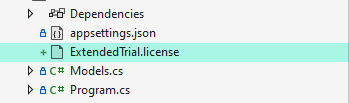
To install your **.license** file, simply add it to the projects root folder and set it to "Copy Always".
Installation on a deployed application is exactly the same! Make sure the **.license** is in the executable directory.
{% hint style="success" %}
#### It's very important to set the "Copy to Output Directory" to "Copy Always" under the property inspector - otherwise the build can't see the file!

{% endhint %}
## Basic Configuration
To actually use the logging, we need a basic **appsettings.json** file in the project.
**A) Either drop the included sample configuration into the project**
{% file src="/files/WNyTDfLt8lN1s3xa6oyp" %}
**B) OR - Create the file (****appsettings.json****) in the root of the project with the code below:**
```json
{
"ConnectionStrings": {
},
"AppSettings": {
},
"Perigee": { "HideConsole": false },
"Serilog": {
"MinimumLevel": "Debug",
"WriteTo": [
{ "Name": "Console" }
]
}
}
```
{% hint style="success" %}
#### It's very important to set the "Copy to Output Directory" to "Copy Always" under the property inspector - otherwise the build can't see the file!

{% endhint %}
We will cover additional logging and configuration in [/HelloLogs](/getting-started/hello-logs.md) later!
## A quick word on "Using" Statements
Since we use Serilog, you may be inclined to use those namespaces at the top of your code. Typically speaking, we import the `Microsoft.Extensions.Logging` package instead. Since Serilog extends that generic functionality, we can do everything we need to with its inclusion. To get access to the logging functions, put this include at the top of the project:
```csharp
using Microsoft.Extensions.Logging;
using Perigee;
```
You can always click the :bulb:icon or press `ctrl+.` to find missing namespaces:

That's it! Perigee is installed and ready to go. Head to the next section, let's write our first "Hello Perigee!" application
---
# Agent Instructions
This documentation is published with GitBook. GitBook is the documentation platform designed so that both humans and AI agents can read, navigate, and reason over technical content effectively. Learn more at gitbook.com.
## Querying This Documentation
If you need additional information that is not directly available in this page, you can query the documentation by asking a question.
Perform an HTTP GET request on the following URL with the `ask` and `goal` query parameters:
```
GET https://docs.perigee.software/getting-started/installation-and-project-setup.md?ask=&goal=
```
`ask` is the immediate question: it should be specific, self-contained, and written in natural language.
`goal` is what the user is ultimately trying to achieve, the reason they need the answer. Sharing it helps GitBook give you a better, more relevant answer. A goal is most helpful when it describes the outcome the user wants rather than restating the question. For example, with `ask=how do I create an API token`, a goal like `automate deployments from our CI pipeline` lets GitBook tailor the answer to that use case.
The response will contain a direct answer to the question and relevant excerpts and sources from the documentation.
Use this mechanism when the answer is not explicitly present in the current page, you need clarification or additional context, or you want to retrieve related documentation sections.